

Direct Instruction vs. Inquiry Based

For many years, schools and teachers sought to engage students by providing them with research backed approaches such as providing choice or providing autonomy over their learning. While there is considerable research to support the effectiveness of these approaches, the studies were almost always supportive when students already had acquired the skills needed or had a base of knowledge to understand new information. Novice learners need direct and explicit instruction before they can learn and find success through exploration and discovery.
In his recent Substack article titled "Privileging the Already Privileged”, Carl Hendrick writes,
“For decades, the dominant view in Western educational thought has been that children learn best through discovery, exploration, and the construction of their own understanding. In many systems, minimal guidance has moved from a pedagogical option to a default stance.”
However, what we really know is that expecting a student who has not yet acquired skills, knowledge or strategies to learn from an inquiry approach is not the most effective or efficient way to help the student learn.
Using Effective and Efficient Instruction
At Pentucket we have worked for several years to distinguish the difference between these two approaches. To be clear - we need to use both. Students can benefit from a discovery approach and find success with exploration, but we need to be sure we have built their capacity with the skills and foundational knowledge first. This teaching concept is true across multiple disciplines, but it can be most apparent with math and reading.
Giving students a math problem to solve that is best solved using double digit multiplication, when students have yet to learn or even develop some automaticity with multiplication skills, is unlikely to produce the learning outcome for the majority of students we might hope. In fact, it is very likely to be demotivating for most students as they experience frustration. What often happens in these situations is students are encouraged to use far less efficient methods to solve the problems which may also undermine their ability to understand the concept of the problem to be solved.
This same experience was felt by students for many years in reading. When students were not taught or had not yet developed automaticity with decoding and reading, they were given other strategies to “read” words and make sense of a text. This only further undermined the use of needed skills to be a successful reader. In an inquiry approach, students may be given a pile of words and asked to infer the pattern or rule for themselves. Many students will generalize this rule incorrectly, and these small mistakes compound quickly into larger misunderstandings for reading and spelling. In a direct instruction (DI) approach, to borrow the words from Zach Groshell…”Just tell them!” Teachers explicitly teach the spelling/phonics pattern and give students ample opportunities for guided practice and application of this rule. This leads to faster, clearer outcomes and reduces the amount of guessing and compensating that early readers attempt to be successful.

In one of the largest federally funded studies that compared instructional approaches, Project Follow Through, was able to isolate that DI had far superior learning gains than the eight other approaches studied in the research. In fact, approaches that were largely described as "problem solving” or inquiry based, had the lowest outcomes for students in grades K-3.

Opposite Approaches or Purposeful Strategic Decisions?
Inquiry-based learning and direct instruction (DI) are often treated like opposites, but they’re really different answers to the same question: How much guidance do students need right now to learn something new? Inquiry-based instruction usually starts with questions, problems, or investigations and asks students to generate ideas, test hypotheses, and build understanding through exploration. DI starts with clear explanations, modeling, carefully sequenced examples, and lots of guided practice with feedback, so students don’t have to guess what success looks like. The key difference is where the cognitive heavy lifting happens first: inquiry asks learners to discover patterns and rules; DI makes the rules and patterns visible upfront, then has students practice until the skill/idea is solidified and/or becomes automatic.
A big reason DI matters, especially in the early stages of learning, is cognitive load. When students are novices, “figuring it out” can overload working memory and produce shaky or incomplete mental models. For beginners, instruction that relies heavily on discovery or unguided inquiry is typically less effective and less efficient than approaches with strong teacher guidance (Kirschner, Sweller & Clark, 2006). DI helps by reducing the search space: instead of spending energy wondering what to do next, students can focus on why it works and how to do it accurately.
Research also supports DI’s impact across outcomes and settings. This doesn’t mean inquiry is inherently “bad,” but it means instructional clarity and guided practice are powerful levers when the goal is reliable learning for all students, including those who don’t come with a lot of prior knowledge about a topic. DI makes learning visible and attainable, making learning expectations clear and providing students the information they need to succeed.
Consider learning to play an instrument or a piece of music. For our most novice learners, we would never hand them a complex piece of sheet music and tell them to just “figure it out.” Even after hearing the piece numerous times, this would prove to be immensely challenging unless you had the proper skills and background to be able to play an advanced piece of music. With this approach, a student is more likely to struggle, make mistakes, and attempt to compensate in other ways. It likely often takes a substantial amount of time to learn the piece through this methodology. Through more of a DI approach, the teacher would break down the piece step-by-step and support the student through a gradual release of understanding until they are able to play pieces competently, pointing out places where the student is likely to make mistakes and providing corrective feedback when necessary.
With that said, this doesn’t mean we do not want students engaging in inquiry-based learning at all. Rather, there is an urgency to understand the time and place for inquiry, which is after students have the necessary background knowledge and skills to be able to think deeply and critically about a topic or idea. Once this is in place, students are able to use inquiry to make connections in a meaningful way, to deepen their understanding and transfer learning to new concepts.
The Novice Learner
Dr. Barbara Oakley, a professor at Oakland University, recently published a post that sought to address a flawed design approach to curriculum and what is promoted to teachers around designing learning time in the classrooms. As a professor with numerous publications about education in the STEM field, she has observed a disconnect between what years of research indicates should be the instructional design for the use of time, versus what ends up happening in most classrooms.
“The fact that your brain builds its own representations says nothing about whether that building goes better with more guidance or less. That’s an empirical question. And the evidence overwhelmingly favors more guidance for beginners, not less.
Yet when students taught through discovery and inquiry don’t do well, the framework never takes the blame. The teacher didn’t implement it correctly. The test measured the wrong thing. The scaffolding was insufficient. The culture wasn’t ready. The reform didn’t have enough time.” - Dr. Barbara Oakley
Dr. Oakley’s visual provides us with an easy to understand breakdown that compares the research and evidence driven model of how time should be structured(especially for novice learners) versus how it is often implemented.
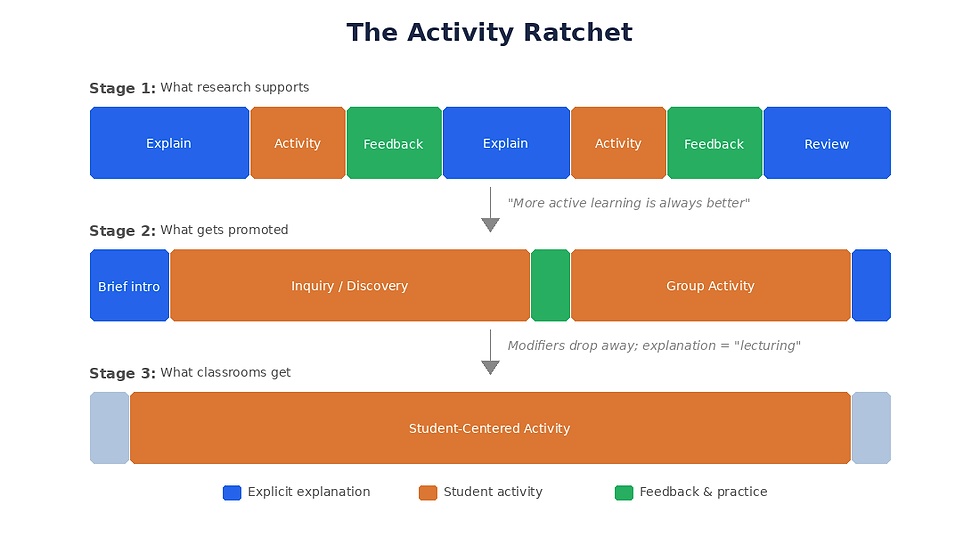
Being a novice learner or requiring direct instruction at the early stages of learning something new is not intended to be solely focused on younger learners. High School and Middle School students are regularly introduced to new concepts and information that requires direct instruction to build their understanding, vocabulary and frame of reference before they can really delve deeply into the concept. One clear example of this is when high school seniors enroll in a class such as Psychology. The content of this class is reliant upon the expertise of the teacher and information in the text and resources used. Most students have little background knowledge. While certainly students in high school take challenging courses, including classes like AP Biology, AP Physics and AP Calculus, these classes just build further extensions from previously learned concepts in which students have already demonstrated proficiency.
In AP Psychology, students do not start working on independent or group projects until several months into the school year. They must first develop the schema for all the new content, concepts and vocabulary. This requires a lot of direct and explicit instruction. Ms. Beaton uses known visual models and multiple means to provide students with critical information to create meaning and a base of knowledge to work from. She knows she is teaching novices, but also knows that without a base of understanding, engagement later on in the content of the course will be nearly impossible.
This challenge persists across multiple content areas, but can be clearly observed in literacy and math. In his recent substack piece, Ammar Merhbi writes about the Aesthetic of Engagement in critique of a particular math instructional approach that has built momentum for use in schools across the country.
“This approach runs counter to Cognitive Load Theory (CLT), one of the most well-supported pillars of educational psychology. Novices do not learn like experts. An expert mathematician can navigate "unproductive struggle" because they have a rich library of schemas in their long-term memory. A novice student does not. By withholding explicit instruction and worked examples, we aren't "empowering" students; we are leaving them to flounder in the dark.” - Ammar Merhbi
Of course we want students to be engaged in learning. To be fair, a teacher standing in front of the room lecturing to 10 year-olds, or just working problems out on the board as students copy them down, is not likely to engage many students and is also not likely to result in meaningful learning. However, when the primary goal is to simply engage students in learning activities without also ensuring they are taught the efficient and effective means to complete the work, the students and teachers get stuck in the “productive struggle” loop - where only those with some skills remain engaged through the struggle and end up being productive. The more and more this approach is used, the wider and wider the gap becomes between those students with skills and knowledge and those without.
The table below is adapted from the work of Merhbi.
Common Inquiry Based Practices | Evidence Based Alternative Practices | What the science and research actually says |
No or little teacher led instruction - leaving it to students to explain | Teacher is focal point in the classroom for direct instruction portion | The most experienced and knowledgeable person (being paid) is the teacher and can be far more efficient with providing instruction |
Random groups of students partnered together | Grouping students by skill need or purposeful matching of varied need | Novices rarely learn from other novices and those with greater skill are not likely to advance their learning. |
Explore and discover first | Explicit instruction and modeling of problems or expected outcomes - with procedures to achieve outcome | Using the structure of models and procedurally worked examples provides novices with an anchor and background knowledge to apply to new learning |
Student white boards for working on problems and questions | White boards, but with structured notebooks | Notebooks promote the recording of work for future retrieval and instruction if misconceptions persist |
Math and Worked Examples
Using worked examples in math, is a well researched and proven method to accelerate student learning and success. We might often think of “worked examples” with more advanced math, where students are engaged in multiple steps of complex math problems. It certainly can be and has proven to be very valuable for advanced math, but it is also critical for younger learners to see how a teacher, who has knowledge, is able to model a simple problem. This Edutopia video provides a great overview of what that looks like.
As students learn a concept in math, the novice learner or even the emerging learner gains great insight from the modeling shown from completing a problem. This type of direct instruction should not be mistaken for practicing simple routine math facts over and over. This method gives clarity to the thinking and application a more skilled mathematician does. As students gain greater insights, less modeling is needed. But without the initial modeling and working backwards from a worked example, so many students take wrong turns, make inaccurate assumptions, or skip critical steps that are needed to master the concept.
As stated earlier, numerous research articles have studied the effect of using worked examples, with several drawing storing conclusions that the method is superior to inquiry based methods for problem solving in improving student outcomes. This 2023 study put this assumption to the test and it provided some clear evidence - “The results favoured worked examples on both the retention and transfer tests after learning and showed that using worked examples would reduce cognitive load and impose less challenge on each step during learning.”
In the district’s recent February early release PD day, Grace Archibald and Rachel Vokey, two teachers at the Page School, provided sessions precisely focused on using modeling and worked examples to enhance student learning in math. The objective of their PD was to help staff understand when students might benefit from the inquiry approach to solving math problems and how and when to provide purposeful direct instruction with modeling.
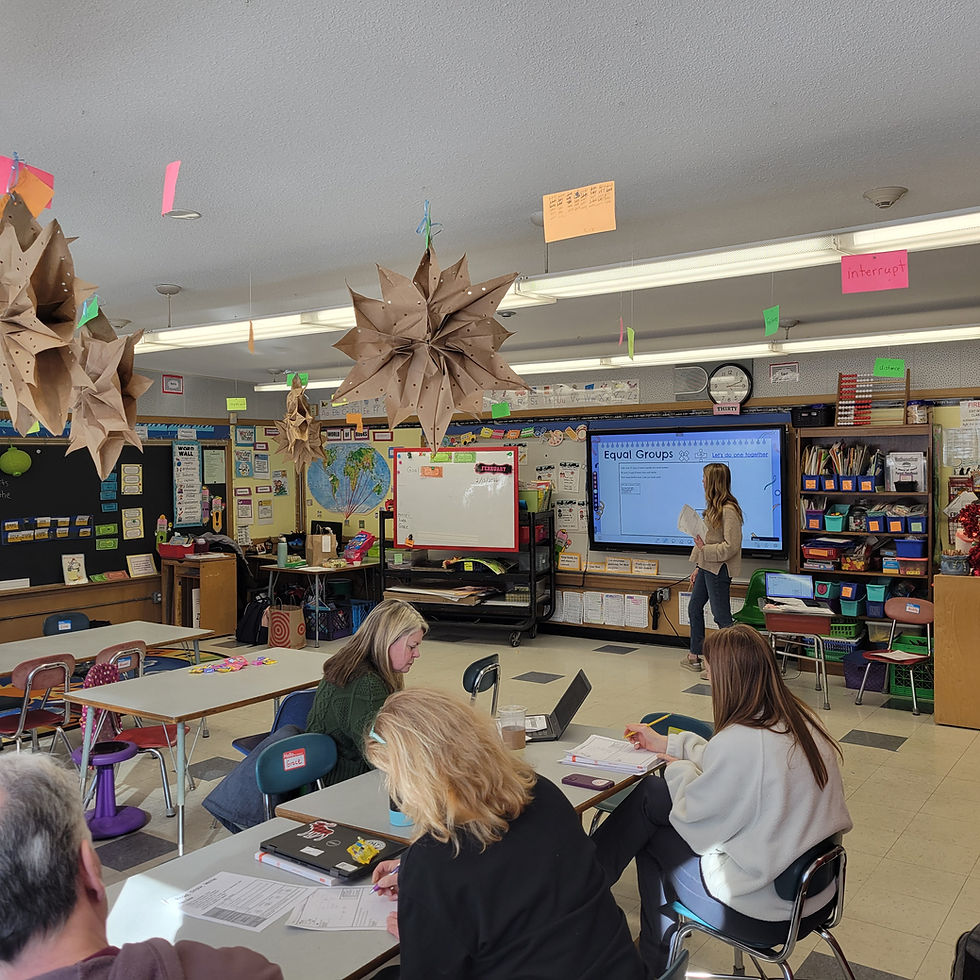
Grace Archibald described how they prepare lessons from the district’s adopted curriculum, Eureka Squared, to always ensure direct instruction serves as the basis.
“Problem solving in mathematics has historically been very difficult for students. Eureka Squared does a nice job of making the abstract concepts concrete using tape diagrams. However, many students need direct instruction in order to understand not only the different types of word problems, but also the different types of tape diagrams.” - Page School Teacher, Grace Archibald

Ms. Archibald and Ms. Vokey co-teach a 4th grade classroom. Their planning together focuses on deep conceptual understanding but ensuring that students, especially those who exhibit difficulties, have instruction on the needed skills to develop the deeper understanding. In the example that Ms. Arhcibald describes above, they work to ensure the students use learned skills and don’t fall into problem solving “traps” when something becomes sufficiently challenging. Once that tape diagram is complete, oftentimes, students may guess which operation to use, and often incorrectly. We can eliminate this issue and create more independence with resources and explicit teaching. In other words - the best way to create an independent learner is to teach them how to develop and use the skills independently, rather than just setting them loose on a challenging problem without having solid skills. Students, with monitoring, begin to internalize the steps, routine, procedures and in turn, a deep conceptual understanding of the four operations. Ultimately, students can then take an inquiry based approach to problem solving that avoids the guesswork.
Writing Instruction
“You can't write about things you know nothing about.” These are the words that Jen Hogan, our Literacy Coordinator, frequently uses to help staff understand how we have changed from our former writer’s workshop methods of “teaching” writing. How we teach writing now vs. how it was taught in a writer's workshop makes so much more sense to staff and it aligns with what research tells us about writing. Formerly, students wrote about varied topics not necessarily connected to text, content or topics they were learning about. Now, we are using a consistent routine of planning writing and the writing is in response to text with an expectation that students incorporate various pieces of information from multiple texts. Writing improves comprehension and helps students to make connections across texts and concepts.
This is not the first time we have written about the incorrect prioritization of student choice, motivation and engagement. While autonomy and choice most certainly enhances motivation, and this is well proven in scientific studies, and without engaged students, learning is unlikely to happen, these are not the primary drivers for student success when a learner is still grasping the basics. In our white paper shared in 2024 titled, “The Balanced Literacy Hangover”, we share experiences and what we learned from our work over several years to shift the systems from an inquiry based workshop model to a structured model that leaves little to chance for students.
Providing direct instruction to novice learners as they build the schema and skills to tackle more complex learning is the basis of the instructional approach in Pentucket. We want students to use their foundational skills and acquired knowledge to apply it to more complex concepts and tasks. This is the thinking we want to develop, enable and enhance - which in turn puts kids in a position to learn effectively through discovery and exploration when the time is right for them to engage in that work.
Dr. Brent Conway
Assistant Superintendent
Pentucket Regional School District
Jen Hogan
K-6 Literacy Coordinator
Pentucket Regional School District


Comments